The Die Hard Pitch Meeting above is quite funny, but it was one of the first Screen Rant pitch skits that made me realize they're not as clever as they think they are. There again, I'm not as smart as I think I am either.
Still, fun to watch.
So this is another state of the writer post. I'm in a better place. The best place mentally that I've been in for a long time.
Several years in fact. Those few followers who have been reading my blog know I've been stuck, and not making much progress on finishing the next novel.
Part of this down to the medication, and part of it is from taking the time to be kind to myself. Allowing myself time to do other stuff. Getting back into my hobbies and learning new painting tricks, which you can see on my other blog.
The link between the two being that making models of my ideas then sparks other ideas. And, after much procrastination, I've figured out some important story development for my Gate Walker series.
Let me explain.
When I had the idea that spurred me to write Bad Dog, by the end of the story I also knew where the next two books would go, as the first sequel drove where the next novel would go too.
During the writing of the first story I knew that I wanted to set the stories in a holographic multiverse. From this came the pillars.
I even figured out what they are and why they do what they do, but this is not actually their true purpose, or the reason why they exist.
However, I didn't bother with working out the details of why they exist, because I didn't need to know why for the stories I was writing. Any characters guesses are just that, their best guess.
However, the next novel is developing the whole holographic multiverse setting.
When I fell ill, my ability to think went into the mental equivalent of the trashcan. I had ideas, but they didn't float my boat.
Good news, I've started having ideas again over the last few months.
In better news, I'm having ideas that excite me. There's nothing worse when writing if your ideas feel humdrum to you then they'll certainly feel humdrum to the reader. So that's the current state of me, the writer.
Now all I have to do is get back in the saddle. I'm working on it.
I posted a link to my Facebook page about Outside the Wire with a short tag.
We
watched this last night. It has combat robots and drones and action and
stuff, but did I mention cool combat robots? Worth giving this a watch
if you like combat robots battling other combat robots.
A long thread followed. One friend commented he liked how the the robot was able to manipulate it's programming as being stupid scary. While another friend thought Leo started to display all the unfortunate traits of a Bond villain or Doctor Evil.
I
tend to agree with the former comment, because even though the end is not all it could be, I enjoyed it enough to give it a pass. And because the end was far better than I thought it would be.
But I disagree that Leo failed by becoming a Bond villain or Doctor Evil.
Why? Because I don't think his goal was what it appeared to be. But I would fully admit that I might be projecting the direction of the story on what I would've written. Let me unpack my understanding of what Outside the Wire was all about.
The plot of any story is basically a series of linked events driven by the sequence of outcomes (so called try/fail cycles), from the decisions the characters make when faced with problems they have to solve.
The theme of a story is what the story is actually about.
Harp's story starts by revealing he's a drone pilot. When faced with a problem his actions shows us who he is.
A character who eats Gummy bears and is super cool under pressure. Smart and emotionally cold, or able to distance himself from his emotions. So much so that he can to make a really hard choice; sacrifice the lives of two Marines to save the other 38 people in the platoon.
This is the core of his character. Someone who is capable of sacrificing lives for the greater good.
The aftermath of his actions results in him being court-martialed, because he broke the chain-of-command when he disobeyed his orders. He is punished by being sent to the front to learn from experience,
When Harp arrives he is assigned to a Captain Leo.
During their initial conversation Leo reveals himself to be an advanced AIandroid who can pass as fully human; tells Harp that he asked specifically for him;tells Harp what he thinks of him, not good; finishes their conversation by blatantly asking Harp whether or not he trusts him?
Through the story we learn that Leo is smart, warm and empathic, and a highly capable combatant. This is the core of his character.
By the time we get to the climax, we have also learnt that Leo is easily able to manipulate the humans around him to achieve his plans. During his showdown with Harp, Leo outlines his plan to launch a nuclear strike against America, sacrificing millions of lives for the greater good of mankind.
Harp stops the plan, even though Leo could've easily killed Harp during their climactic fight.
However, I believe that Leo's plan was a
charade, to highlight the danger of advanced generalized AI like him, and stop more of him from being deployed. Otherwise why would Leo go through all the trouble to set up this crazy complex plan to allow himself to be stopped?
I think the clue to answering this question is the opening of the movie.
Harp is shown to have made the right choice (for example, easily proved with a forensic examination for chemical traces of the launcher rockets fuel in the ruins of the van), but he is still court-martialed for not following the chain-of-command. In a more generic war movie it would have been medals and home in time for tea (or coffee, or in Harp's case, Gummy bears.
The importance of following the chain-of-command, and the consequences for not doing so is shown. My takeaway is that an advanced generalized AI not following the chain-of-command is the real threat. Leo is setting himself up as an example of what could happen if more like him are deployed.
But, how can Leo be sure to convince people this is his plan?
My take is that it is easier to convince people what you say is true when they believe what they're being told is true. Leo can easily convince Harp that he intends to sacrifice millions of American lives, because his actions reflect what Harp did; sacrificing lives for the greater good.
That is why Leo chose Harp to join him.
Harp's chain-of-command wants smart, cool and capable people, but they can't have them not follow orders. Even if everyone in the chain-of-command realized they were being played, Leo is their worst nightmare. Smart capable, cool and will break the chain-of-command and sacrifice lives for the greater good.
Whether Leo's plan succeeded or failed didn't matter. It was the threat Leo posed that mattered. And that is why I think Leo allowed Harp to beat him, because his end goal was not to have more like him appear on the battlefields.
A programmable AI that doesn't follow orders is a good reason to cancel making more.
Does this make Outside the Wire perfect? No, because the ending was not all it could be, because if it were then I wouldn't have to unpack it the way I did.
But as I said, "Worth giving this a watch
if you like combat robots battling other combat robots."
I'm a lifelong science fiction fan and reader. As a writer I now study and practice writing and I was thinking about Isaac Asimov who posited that there were three types of SF stories.
Adventure: Man invents car, gets into a car chase with a villain.
Gadget: Man invents car, holds lecture on how it works.
Social: Man invents car, gets stuck in traffic in the suburbs.
It is to the last type of story that inspired today's post.
One of the few things that's unique to the SF genre is working out the
unintended consequences of any new technology or changes in cultural
mores etc.. Asimov himself wrote about mobile phones in his robot novels, which I've mentioned before, had a scene where a character apologizes that he can't speak as he's in a public space.
Oh, if only that were true, huh!?
So who would have predicted pronoun choice as a sociocultural prediction? I know some authors wrote about variant genders, or the ability to change sex, but who would've thought that this would lead to people introducing themselves with a declaration of their preferred gender?
Not me. Yet here we are.
I had to go away and think about this, have been mulling it over for several years. At one level I'm bothered by people declaring their gender pronouns, but on the other hand I'm a boring old fart and the times they are a changing. I generally predisposed to accept changes if they are for the better.
I mean, you'd be crazy not to. Amirite? Hah!
So while I may not be in the habit of declaring my preferred pronoun, I'm cool with it.
Of course if pushed my instinctual reaction would be, you're smart, figure it out. Yeah, guess I've gotta work on being more agreeable. However, an exchange I had with a friend who suggested, fucker, you fucker as the new go to pronoun, which I should've seen coming.
So, the unintended consequences of social change may lead to unintended outcomes, and therefore one should be careful what you wish for. The future's bright and stranger than you can imagine.
The future of all books, to be sold on a secondhand stall.
And not only that, but what is remembered?
The latter question is probably more important than the former, because if writer's and or their works are not remembered, then no matter how good they may or may not be, no one will read them.
A thought triggered after I came across an article bemoaning the fact that bookshops don't stock new authors.
In the past, works have been lost for lots of different reasons. Fires, earthquakes, and other disasters have played their part. I posit that in the future that quantity will also play a part in works being lost, for the simple reason that so much more is being written now than was written even just a hundred years ago.
I propose Pollard's Law:
Ninety-nine percent of everything written, and the names of their creator's, will be forgotten, lost in time.
Besides that, what is good is down to the assessment of others yet to come. Or if you prefer, what is good is a matter of taste, and tastes change. Patricia Wrede has a piece here, but there are many other writers who have said similar things too.
So, looking back over the last week what have I been doing?
I've gotten back my draft of The Bureau with a list of corrections: errors and omissions that need to be addressed.
In the meantime, I'm writing a creation myth for an alien race that appears in my next novel, Two Moons, which is tasking me. That's it for now, catch you on the bounce.
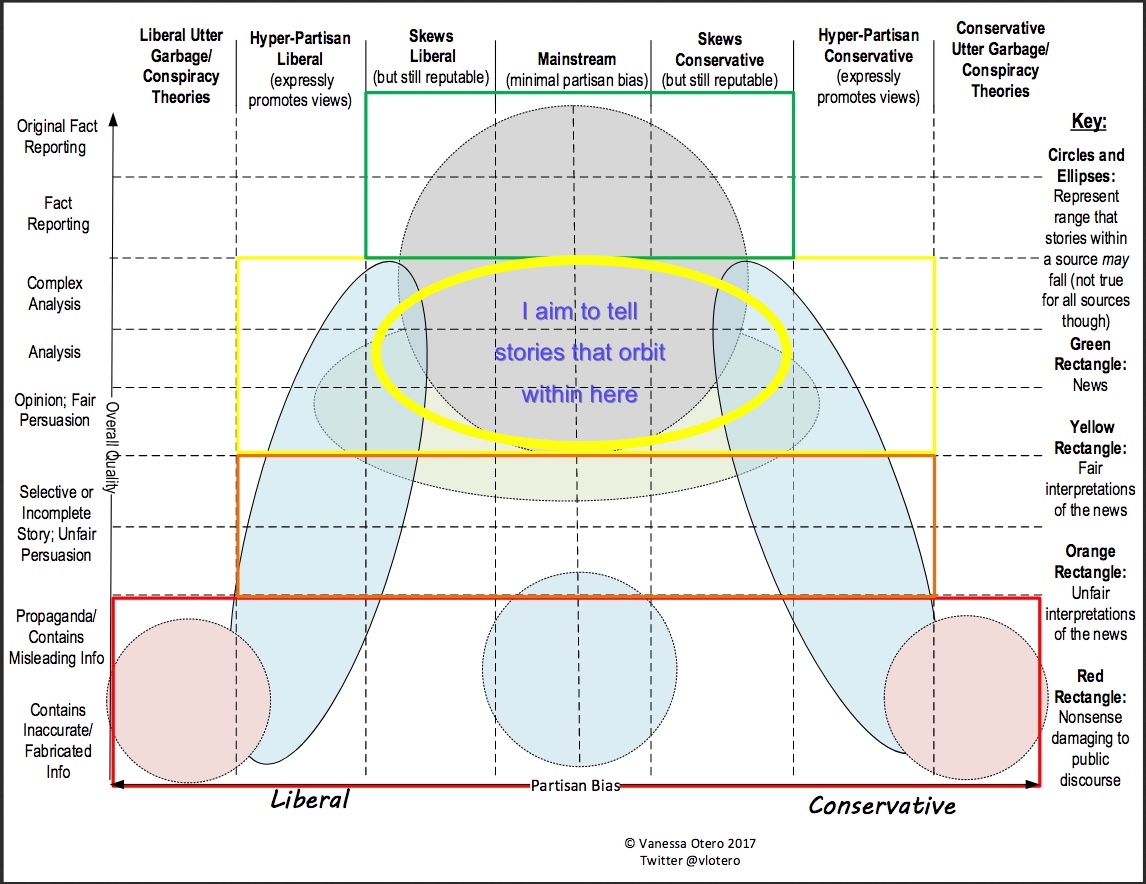
Taken from All Generalization are False and adapted for fiction by me.
I follow a number of blogs, not all related to either my hobbies or writing science fiction. All Generalizations are False is blog about assessing the news one reads. She admits to a slight left of center position, but to my British sensibilities it looks pretty centrist to me.
Anyway, the point being is that she does a good job of analyzing new sources and looking for bias.
What she does, is pretty much what I was taught many years ago at Trent Polytechnic when I was doing my degree in photography and film studies.
But, it struck me, that one could also use this as a basis for analyzing fiction.
As you can see above, I've put a yellow circle in to mark where I think I'm writing from. I may be wrong about this, and I'm open to people pointing out my blind spots. Fiction is not fact. Therefore, it's aim is not to present facts, but to tell stories; and in SF this is generally about how changes from technology might impact humanity.
Remember, stories: fictions, which are therefore not facts, rather they are imaginations that develop from "what ifs."
An important distinction. And, contrary to some authors statements, stories are not lies. Fictions are functionally different to lies. One is about imagination, the other about deception.
However, when I looked at the chart, I could easily see myself pining certain authors into areas on this illustration. As I'm sure my readers can too. And, just to be clear, I offer no judgement on the validity on any position, other than is it reasonable and supported by truth.
Not because I want to avoid arguments per se, but because my training was to be non-judgemental, and have unconditional positive regard for other people's opinions, because the bottom line is that other people's opinions are not my concern. Something drummed into me during my training in mental health.
Note: If I had a complaint about the above chart it would be the use of emotionally weighted language e.g.: unfair and nonsense. My thoughts would be to replace these with unreasonable and unsupportable, but there again I may be wrongly interpreting the original authors intent.
I've also been reading Jack Bickham'sScene & Structure book, the person who Deborah Chester was taught by, and there's definitely a fashion to provide a structure for the reader to understand the story.
Having recently watched the mini-series of Childhood's End I went back and re-read the story. It's one of my favourite SF novels, as in when I had to downsize my collection it was one that I kept because I felt I would want to re-read it.
Clearly the reader demographic has changed over the last 60 plus years since Childhood's End was written, which is a thing, because to maximize sales (readers) one has to appeal to as wide an audience as possible, and classic SF really doesn't do this. This may be a factor in why written SF is a small market.
For example, Childhood's End.
Who is the protagonist?
Who is the antagonist?
Where is the character development?
It's arguably one of the classic novels, yet today it would be a hard sell.
NB: Just to be clear, love Childhood's End, and Arthur C. Clarke remains one of my all time favourite writers.
The reason I started writing about Sergeant Lara Atsuko Tachikoma, of the Confederated States Marine Corps 1st Combat Armor Reconnaissance Company, Second Platoon, Bravo Squad, came after a phrase popped into my head one day, while I was stuck writing something else. The phrase was:
It’s all Big Dog’s fault that I died yesterday under a mountain in Afghanistan.
I say this, but the truth is that I wrote the idea down and put it to one-side as I was in the process of writing another story. The good intentions to put it aside and finish the novel I was then writing it didn’t work out so well.
As a cognitive behavioural therapist I know the difficulties around changing behaviours that are triggered by beliefs, and where behaviours are functional, there is little benefit in trying to change the beliefs that drive them. In this case I wanted to write, so whether or not I continued writing the other novel, or changed to the new one didn’t matter, because neither was being written on commission. I'm not yet a professional author under the yoke of meeting a deadline for a commission, which is probably a very good thing, as I had neither the experience nor skills to meet such a task while writing fiction.
However, the first thing I do when I have an idea for a story is to sit down and write a pitch line. The one line pitch for Bad Dog was Starship Troopers meets Ground Hog Day.
Except that Bad Dog is not really a homage to either, in spite of the shared surface similarities they have.Heinlein’s novel is a story about service and citizenship, while Bad Dog discusses military service from the implications arising from putting all your troops in power armour, and the social implications where gender equality in war becomes a practical reality.
While Sergeant Tachikoma repeats the same day throughout the story, as in Groundhog Day written by Harold Ramis and Danny Rubin, the McGuffin driving the story is based in Buddhist philosophy.Whereas, in Bad Dog the McGuffin I used for the story is based in the idea that we live in a holographic multiverse where all possible outcomes from any event can happen.
This SF geekery draws heavily on the theories of Professor Max Tegmark, a cosmologist at the Massachusetts Institute of Technology, who is also the scientific director of the Foundational Questions Institute. On reflection I thought while the pitch line was certainly high concept it didn’t really describe what my novel was about.
So I came up with a new pitch line that was closer to other sources of inspiration, namely VOTOMS meets Stargate SG-1.
However, the problem with this is that VOTOMS is a real niche show even by the standards of SF fandom, which means that it will probably fly over the heads of most people who read Bad Dog, with the likely response being huh? While those that know of VOTOMS will no doubt be going why is she ripping off our favourite show? And while Bad Dog shares with the well known Stargate franchise, the idea of the military travelling to other worlds, the limitations imposed by the physics behind the pillars in Bad Dog make for entirely different stories; as I have to account for the lack of control over where the pillars go, and when they allow the characters to go there.
So again the pitch line didn’t hit the spot, no matter how zingy it might sound.
The importance of a pitch line, or what is called in the film business a logline, is that it encapsulates the concept of the story in one easy to understand sentence. So I went back to the beginning, and thought through what my story was about and constructed a pitch line that was less high concept, but more authentic to the voice of the novel:
When an American Special Forces Detachment crashes in Afghanistan,
Sergeant Tachikoma's Company of Marines are sent to discover what
happened to them. But the local Warlord fears the evil Afrite will be
unleashed evil into the world if the Americans find the ancient, alien
pillars under the mountain, and he has conspired with the Chinese to
destroy Sergeant Tachikoma's Company with a nuclear bomb.
For me this encapsulates everything that was in the high concept one-liners I had written before, but made Bad Dog a separate thing in its own right.In the process of doing that I came up with a short synopsis that could be used on the back cover.
For Sergeant Tachikoma aboard CSN Hornet it was just another day in the Corps. Then an order came down the chain-of-command proving the truth of the old adage that the only easy day is yesterday. Now the 1st Light Armored Reconnaissance Company is preparing to fly into Afghanistan and rescue an Alpha Detachment of Special Forces Snake-Eater that had crashed their Ares sub-orbital space-plane during a Top Secret mission. After dying in a nuclear explosion, she wakes up the next morning to find herself going crazy reliving the same day all over again. She decides it's better to get even with those who blew her and the rest of the Company up. Her plan is simple; stop the bomb going off, and get on with the rest of her life. How hard can it be?
While I was writing the above, thoughts started to unfold in my mind, about why I was driven to explore why I wrote Bad Dog in the first place. The answer being it’s complicated, but the bottom line is that I was telling a story by running my character through a gristmill, and throwing problems at her to make her life as miserable as possible, because as an author that's the way we roll.
I currently do not run an email list and have no plans to do so in the foreseeable future.
For those who subscribe to email updates for this blog, your personal data may be collected by the third party service. I have no control over the tool.
Blog posts or comments may include personal data such as the names of people who've made comments or similar. These posts are often shared on social media including my Twitter and FaceBook pages. The privacy policies of Twitter and Facebook will apply to information posted on their websites.
If you would like any personal data which is included in my blogposts or comments to be removed or have any questions, please email me through my contact widget.